The systems that run the software.
Stations, servers, access and backups: Agedis supports the IT environment on which the application is based.
Discover Agedis servers and systems
A module takes its value in the course it completes. Dtouch develops and integrates functions Dolibarr to link external management, teams, documents and tools.
See before talking about it
Team planning, mobile voucher and document to prepare: discover the need, the action and the expected result from the demonstration interfaces.
Explore demos →Interfaces used to organize work, prepare data and track files. Each screen shows a specific function, with presentation data.
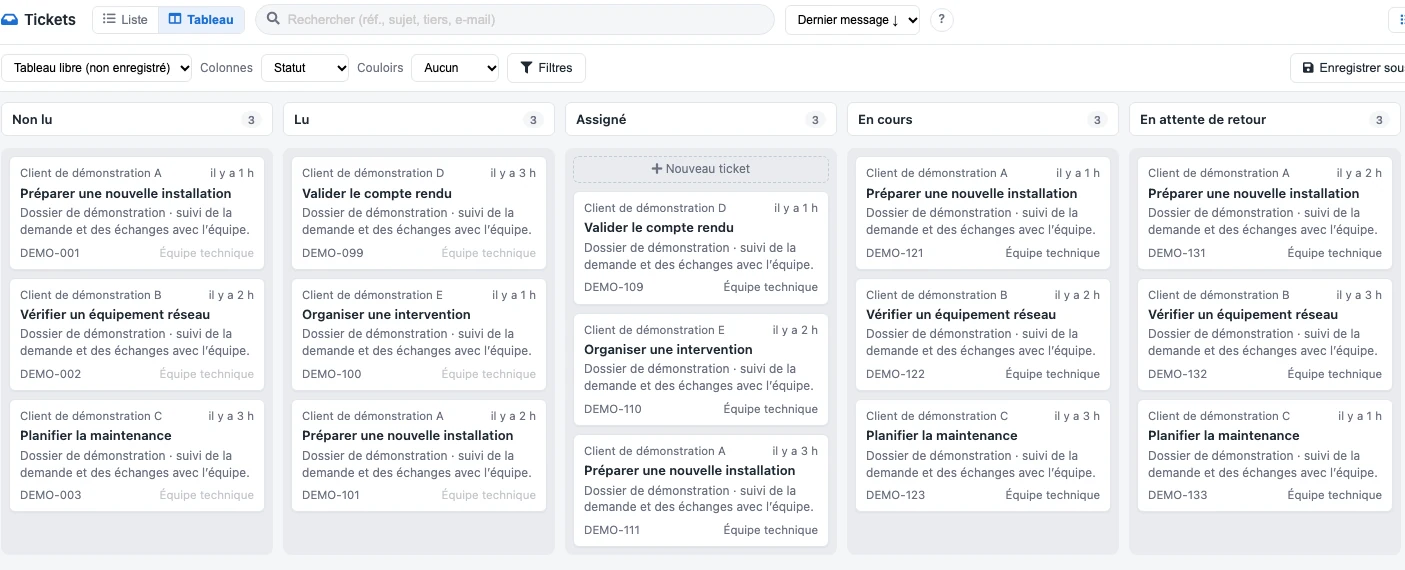 Enlarge screen
Requests are grouped by status, with their subject, an overview of the exchanges and the team in charge.
Real interface · test environment · demo data.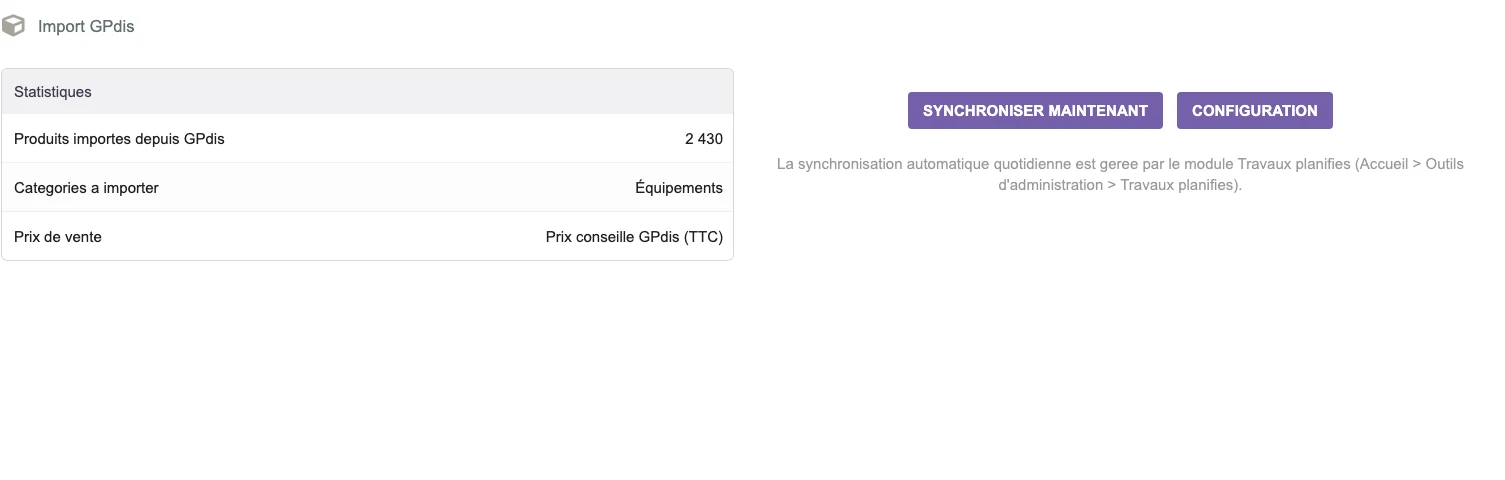 Enlarge screen
The GPdis interface presents the statistics, the target category and the choice of the selling price before import.
Real interface · test environment · demo data.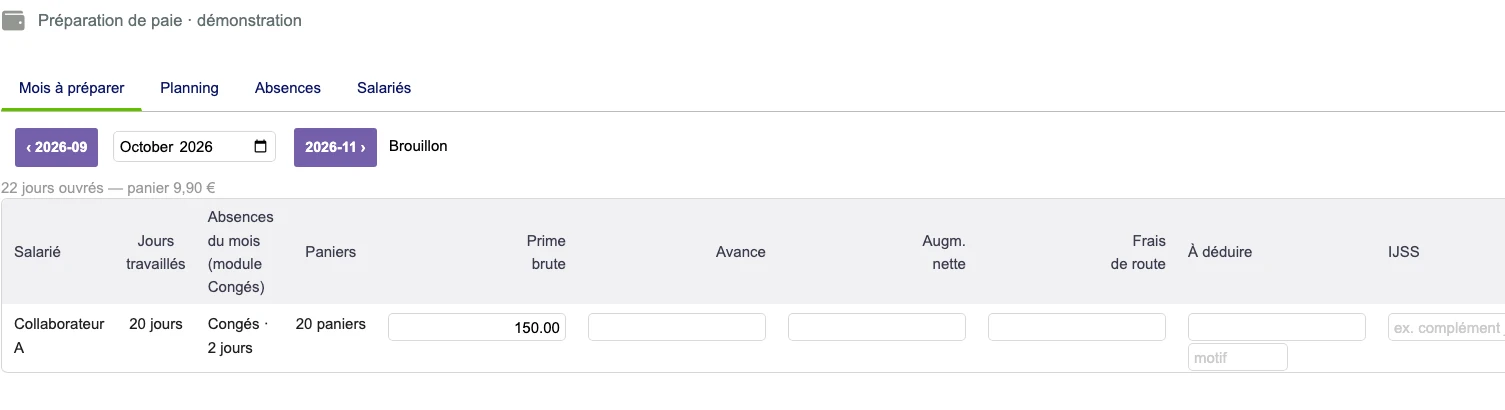 Enlarge screen
Days, absences, baskets and variables are prepared in a monthly view, linked to planning and employees.
Real interface · test environment · demo data.We examine the objects already used in the ERP: third parties, products, quotes, orders, invoices, interventions or projects. The need is placed in the work stages and user rights.
This reading makes it possible to identify the function to be added, the information to include and the actions which must remain consistent with the operation of Dolibarr.
The development may concern a form, a list, an entry aid, a control or a treatment. The extensions work with the objects and integration points of the software.
Existing uses include planning, mobile vouchers, document imports, product searches and PDF models. Each function must join a usable path.
A module can consume a supplier API, prepare an import or synchronize data with another tool. Correspondence and updating rules must be explicit.
Processing takes into account errors, duplicates and restarts. Those responsible for monitoring must be able to understand what has been addressed and what remains to be monitored.
The checks concern the business process and the articulation with the other installed modules. The provision must be prepared in the environment concerned.
We support users and technical monitoring. Documenting rules, data and dependencies facilitates ERP developments.
Project Dtouch
Technical planning, exchanges with Zimbra and mobile vouchers: link the office, the technician and the file.
Explore the caseProject Dtouch
Pass data from suppliers and parts received into understandable and verifiable management documents.
Explore the caseProject Dtouch
References, categories, rates and images: A useful catalogue also depends on how its data is fed.
Explore the caseA specific need, a software to evolve, a project to frame.
Stations, servers, access and backups: Agedis supports the IT environment on which the application is based.
Discover Agedis servers and systemsCloudlab covers the data center and hosting component. The resources and operating conditions are prepared with the application project.
Understanding the Cloudlab data center baseBefore starting development
The framework describes the users, the screens, the data to be collected and the exchanges with your tools. The proposal distinguishes between priority functions, options and monitoring. Reliable encryption depends on this perimeter and access to existing information.
The project is prepared with milestones and verification scenarios: a usable function, a data exchange or a produced document. Expected deliveries and validations are specified for each stage, with a schedule adapted to the scope.
Rights to specific code, provision of sources, documentation and access to repositories are specified before commitment. Standard components and third-party extensions retain their own licenses. The formats for recovering your data are also to be expected.
A new request is closer to the planned scope: correction, accuracy or additional function. Its impact on the budget and timetable is presented before deciding on its implementation.
Corrections, updates, developments, backups and interventions on hosting are separate subjects. The proposal specifies those who are supported, the responsibilities and the modalities of assistance.
The starting point can be a configuration, an extension, a connection between software or the resumption of an application. The framework is used to choose the useful scope and to preserve existing data and uses.
Complementary expertise, the same high standards.