Understanding the profession
Starting from the documents, gestures and constraints of the people who will use the tool.

Frame the need, prepare developments, check uses and ensure monitoring: a working method for developments and integrations Dtouch.
Quality depends on the technical choices and the organization of the project: understanding the uses, associating the right skills and keeping a legible follow-up.
Starting from the documents, gestures and constraints of the people who will use the tool.
Work on a defined perimeter and preserve the existing one by a copy or a suitable backup.
Provide testing of the actual exchanges, documents and routes used by the teams.
Document, transmit and coordinate monitoring with users, developers and partners.
The starting point is a concrete use: prepare a quote, find a document, process a request or publish a catalog. We look at the examples and steps of working with the people involved. This preparation provides a clear scope for development and testing.
A working copy, a suitable dataset or a backup can preserve the existing one during an evolution. Developers, contributors and partners are involved in defined responsibilities. Dependencies with systems and accommodation are examined with Agedis and Cloudlab depending on the project.
The controls relate to the exchanges, data and routes concerned. Field feedback and user tests are used to verify the correction. A validated quote, a delivered development and an accepted result constitute distinct stages: monitoring allows you to find what has been done and what remains to be organized.
The decisions, limits and consequences of the intervention must remain understandable. Follow-up may include documentation, training, resuming a file and coordinating with a publisher. The historical experience of the founder, Patrice Salib, with the Reymann teams and other partners, nourishes this practice without being confused with all the current achievements of Dtouch.
Understand and prepare
A project moves forward when everyone can find the need, decisions and expected result. We adapt the organization to the size of the file, with documents and checkpoints useful to people who will make the tool live.
The framework brings together the priority uses, the people concerned, the existing tools and the constraints to be respected. An example of a quote, an order or a production file allows expectations to be discussed precisely. The model can represent a screen or a document, with cases sufficiently close to the real work. We also specify the decisions that remain open and the contributions expected, so that preparation is not just a list of functions.
The project identifies the roles: reference user, business manager, developer, graphic designer, administrator and relevant partners. Access, test data and environments are prepared according to their intervention. A working copy can accommodate the developments before they are reported to the reference service. Arbitrations and changes in scope are preserved with their context. This organization especially helps when a topic moves from software to system or from presentation to content.
Each retained function calls for an observable result. A search must find the intended references; an import must respect its rules; a quote must contain the expected information. We choose ordinary cases and useful exceptions, then the competent person validates the result in their use. Reservations are identified with their follow-up: correction, additional content or new decision. Monitoring thus distinguishes between preparation, provision and acceptance.
As required, the elements transmitted include operating rules, useful settings, controls performed and topics to be followed. The interlocutors for the software, system and hosting are identified. A subsequent evolution can then start from what has been chosen and verified. The same care applies to a limited correction and a wider application: the team must understand what has changed and what can then be done.
Complementary skills
An application project may depend on an account, a post, a server or an access to prepare. We link these needs to the software work to organize interventions and audits with the right interlocutors.
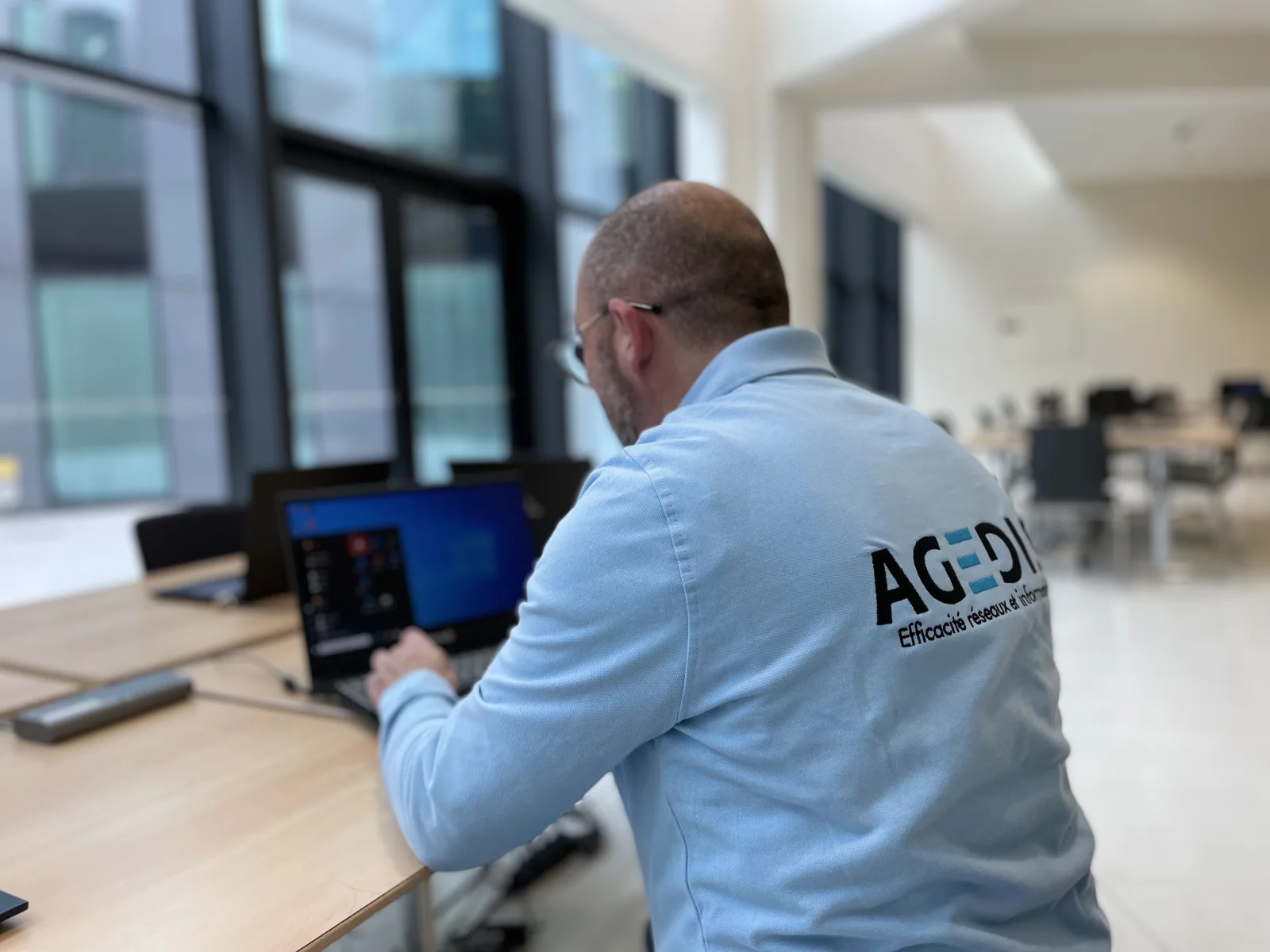
Agedis provides IT and system skills: the photo shows a Agedis worker in a work situation. Dtouch supports agreed development and integrations; Cloudlab completes the data center and hosting component when the project requires it.
The access codes to your applications and environments dedicated to you, the working diagrams and the documentation that we establish are at your disposal. You keep the useful elements to understand your tool and organize the rest with the participants of your choice.
Stations, servers, access and backups: Agedis supports the IT environment on which the application is based.
Discover Agedis servers and systemsCloudlab covers the data center and hosting component. The resources and operating conditions are prepared with the application project.
Understanding the Cloudlab data center baseDescribe the tool, the people involved and what you want to improve.
Exchange on your projectBefore starting development
The framework describes the users, the screens, the data to be collected and the exchanges with your tools. The proposal distinguishes between priority functions, options and monitoring. Reliable encryption depends on this perimeter and access to existing information.
The project is prepared with milestones and verification scenarios: a usable function, a data exchange or a produced document. Expected deliveries and validations are specified for each stage, with a schedule adapted to the scope.
Rights to specific code, provision of sources, documentation and access to repositories are specified before commitment. Standard components and third-party extensions retain their own licenses. The formats for recovering your data are also to be expected.
A new request is closer to the planned scope: correction, accuracy or additional function. Its impact on the budget and timetable is presented before deciding on its implementation.
Corrections, updates, developments, backups and interventions on hosting are separate subjects. The proposal specifies those who are supported, the responsibilities and the modalities of assistance.
The starting point can be a configuration, an extension, a connection between software or the resumption of an application. The framework is used to choose the useful scope and to preserve existing data and uses.
Complementary expertise, the same high standards.