
Functional recipe & application quality
The recipe connects the initial need to the usable result. Dtouch organizes checks with business teams and developers, including documents, exchanges and error recovery.
Concrete functions.
Tools in situ.
Interfaces used to organize work, prepare data and track files. Each screen shows a specific function, with presentation data.
 Enlarge screen
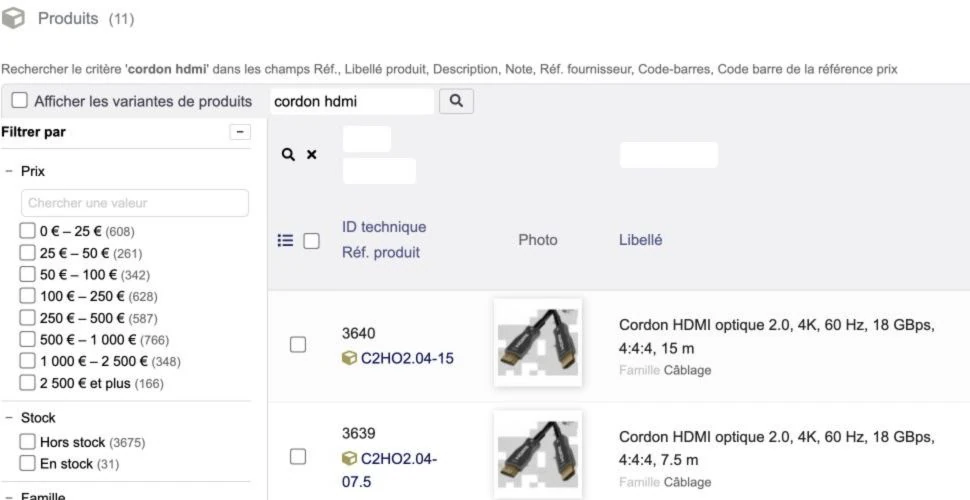
Find a reference among the variants
Search, faceted filters, photos and references help compare catalogue products.
Real interface · test environment · demo data.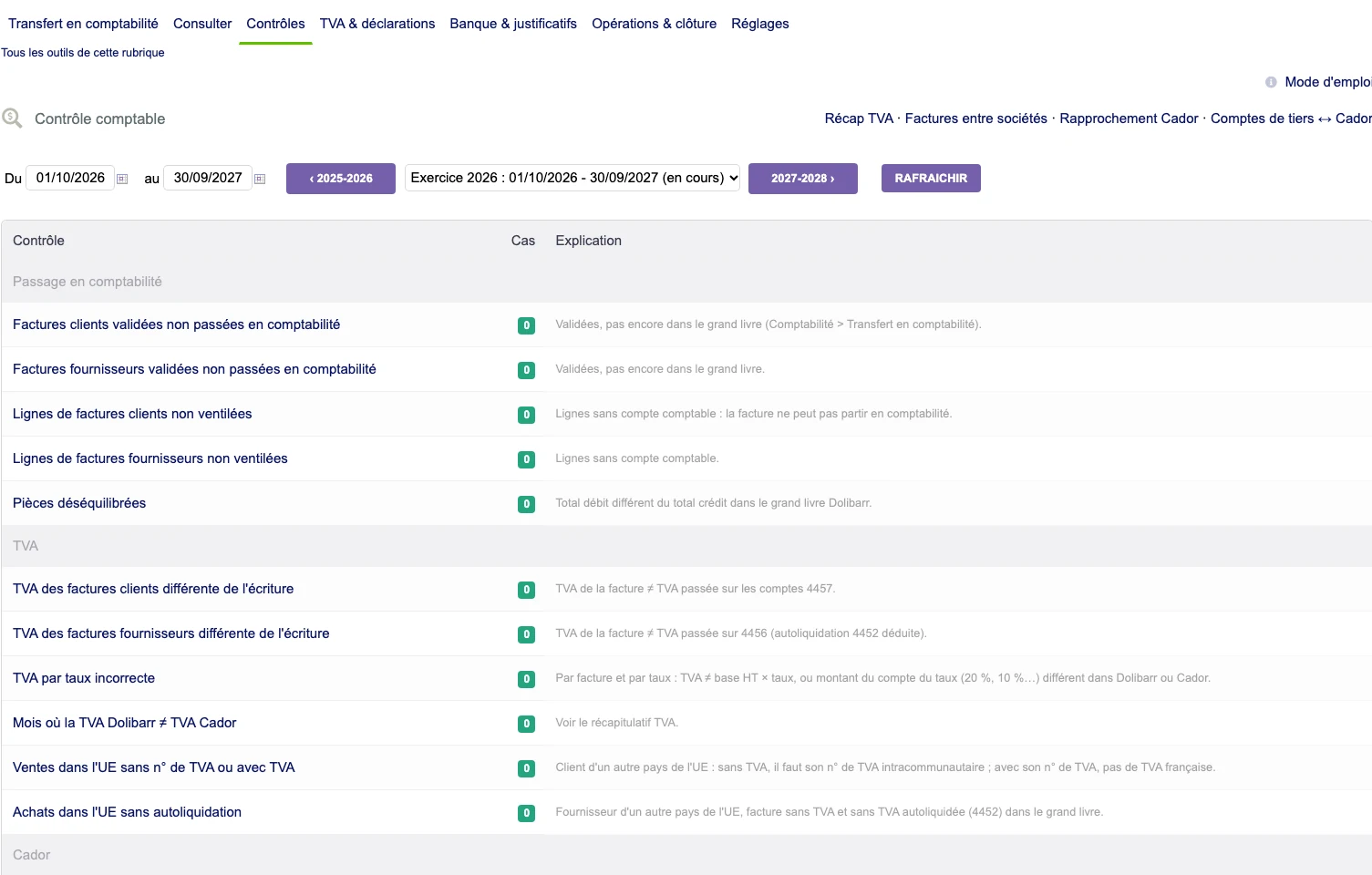 Enlarge screen
Identify variances before transfer
A checklist brings together invoices, breakdown, VAT and accounting, with the number of cases and their explanation.
Real interface · test environment · demo data.Describe scenarios that represent the profession
A scenario specifies a starting point, the actions carried out and the expected result. It may relate to creation, modification, validation or document production.
Important cases also include missing data, insufficient rights and interrupted operations. The verification must provide benchmarks to understand the observed discrepancies.
Follow the exchanges beyond the screen
An interface can show a successful action while a server processing remains pending. The tests follow the request in the relevant components: data, files, API and tasks.
Editorial channels and business applications provide concrete examples: pages generated, images flipped, documents imported and information synchronized.
Organize feedback with developers
An anomaly must be linked to a reproducible case: context, data used, step and result obtained. Returns are close to project scope and priorities.
This coordination avoids dispersing corrections between several teams without checking their effect on the entire course. The result is monitored after intervention.
Prepare for verifiable commissioning
The recipe is accompanied by controls on resources, access and the environment. Users have the information they need to get back to work.
After commissioning, the feedback feeds into the monitoring of the solution. Verifications and documentation provide benchmarks for subsequent developments.
Manage developers and project dependencies.
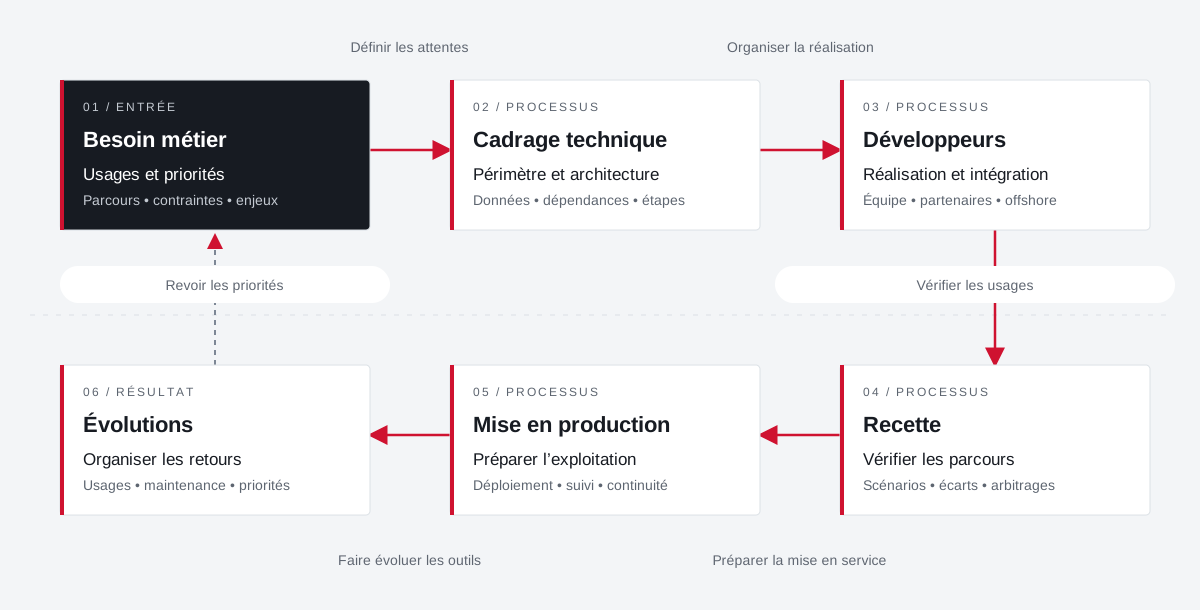
The technical management role brings together business teams, developers and specialists to maintain consistency from framing to production.
 Enlarge the diagram
- 01Set expectations ↓
Business need
Uses and priorities
Journey • constraints • challenges - 02Organize the production ↓
Technical framework
Perimeter and architecture
Data • dependencies • steps - 03Checking uses ▼
Developers
Implementation and integration
Team • partners • offshore - 04Preparing for commissioning ▼
Recipe
Check the routes
Scenarios • differences • arbitrations - 05Develop tools ↓
Put into production
Preparing for exploitation
Deployment • monitoring • continuity - 06
Developments
Organize returns
Uses • maintenance • priorities
Enlarge the diagram Frame
Define expected results and responsibilities.
Coordinate
Treat dependencies between developers and specialists.
Transmit
Make decisions and operating conditions understandable.
Projects and concrete situations.
Reymann : pilot developers and specialists
Founder's Experience · Reymann
Building an editorial platform requires an organization capable of linking internal developers, specialized partners and production teams. The Reymann route gives concrete reality to this piloting.
Explore the caseRey-Active: Connecting a complete platform
Founder's Experience · Reymann
PIM, office applications, web services, image tasks, InDesign Server and business bases: experience in the articulation between the components of a production platform.
Explore the caseDalim TWIST: unify flows and their parameters
Founder's Experience · Reymann
Moving from around twenty production flows to generic flows linked to file data: integration between 4D, Rey’actif, Dalim TWIST and ICC profiles.
Explore the caseYour job deserves
the right tools.
A specific need, a software to evolve, a project to frame.