
FileMaker & management apps
Patrice Salib's IT journey began in 1994 with FileMaker. Understanding the activity and translating it into a useful application has been the guiding principle of his work ever since.
1994: first developments with FileMaker
Before editorial platforms, processing servers and ERPs, there were the first management applications created with FileMaker. The work begins with a concrete question: what information should be kept, who provides it and how will it be used?
This experience of data and interfaces forms the basis of a professional software practice: linking the structure of a database to the operations actually carried out by users.
Model the job before designing the screens
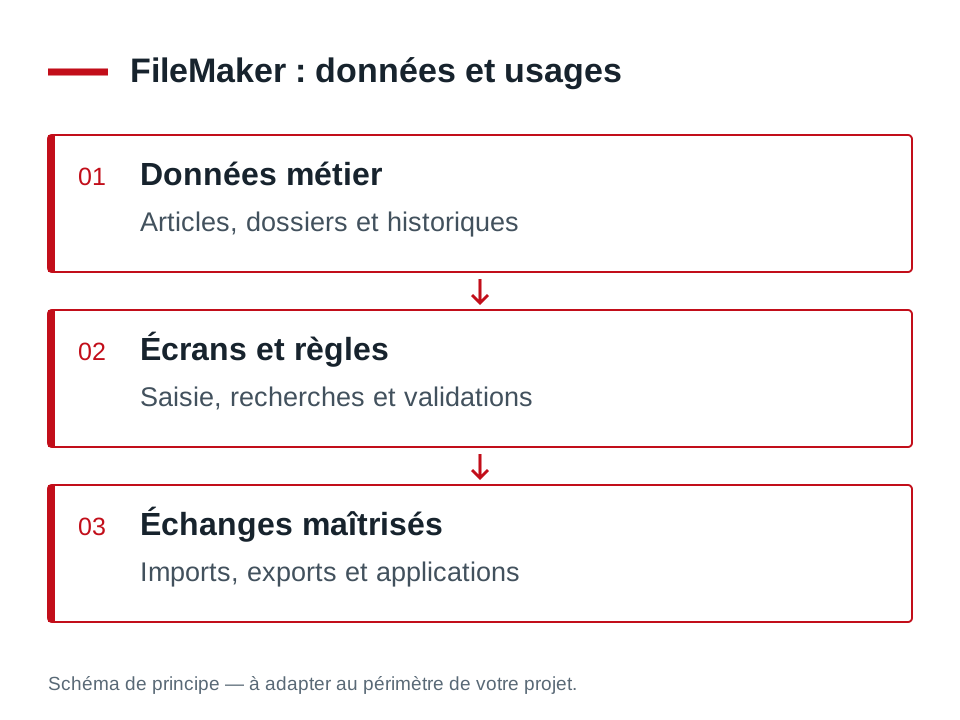
A sheet, list and state only make sense of the relationship between the data. References, files, interlocutors, documents and steps must be described with a common vocabulary.
The design distinguishes between information entered, information that is calculated, and information that comes from another system. It also specifies the control rules to prevent errors from spreading in documents or exchanges.
Develop tools without losing their logic
An older application may concentrate years of practice that are not documented. Before a resumption, we examine the data, screens, calculations and working habits with the people concerned.
Continuity comes through an understanding of this existing, then through the choice of an adaptation, a connection or a migration. The tests must compare the results obtained on representative business situations.
A thread leading to the current platforms
After FileMaker, the journey extends in particular to 4D environments, editorial platforms, PostgreSQL databases and Dolibarr. Technologies change; attention to the relationships between data, rules and users remains central.
Dtouch applies this reading to current projects: defining an understandable scope, building useful exchanges and supporting teams in daily operations.
Projects and concrete situations.
JPEG & PDF: recover information from the heart of files
Founder's Experience · Reymann
Traces incorporated into JPEGs, Apoove annotations, images and attachments: processing to make information usable between applications.
Explore the caseUTS & InDesign Server: linking typography to generation
Founder's Experience · Reymann
A back-engineering around Universal Type Server to make typographies available in the InDesign Server generation chain.
Explore the caseCirculate products between tools
Project Dtouch
References, categories, rates and images: A useful catalogue also depends on how its data is fed.
Explore the caseYour job deserves
the right tools.
A specific need, a software to evolve, a project to frame.